An Organization Dedicated to Advancing Patient Participation

We're on a mission to help every health consumer become a better participant in their care.
Who We Are
The Patient Better Project is a 501(c)(3) nonprofit organization that defines, studies, and measures patient participation that will allow people to better prepare before, during, and between healthcare encounters.
Our Mission
Our mission is to help every health consumer become a better participant in their care.
Our Vision
To strengthen healthcare professionals, organizations, researchers, and policymakers by capturing the participation data that will improve care, quality, outcomes, and the entire healthcare experience.
What Is Patient Participation?
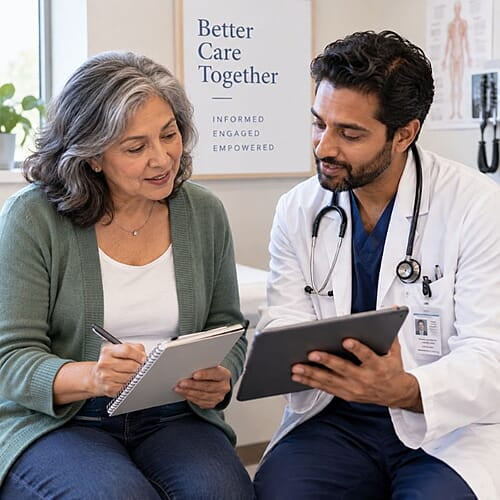
Patient participation is the active role a person takes in navigating, communicating, organizing, and following through with their care before, during, and between encounters.
From preparing for an appointment and communicating relevant information, to understanding next steps, managing health information, coordinating care, and carrying out agreed-upon actions at home.
Patient participation is the patient-side activities that the professionals depend on for information to move, decisions to be understood, and care to continue beyond the clinical encounter.
Patient participation is the active role a person takes in navigating, communicating, organizing, and following through with their care before, during, and between encounters.
From preparing for an appointment and communicating relevant information, to understanding next steps, managing health information, coordinating care, and carrying out agreed-upon actions at home.
Patient participation is the patient-side activities that the professionals depend on for information to move, decisions to be understood, and care to continue beyond the clinical encounter.
What patient participation looks like in practice.
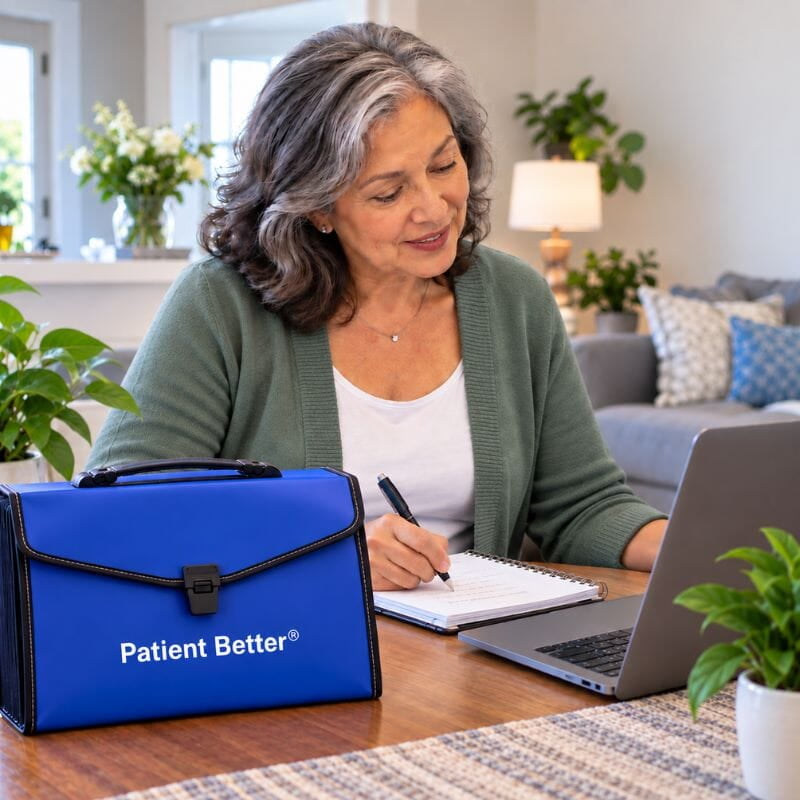
Patient participation is visible in the everyday interactions that keep healthcare moving. It is the patient arriving prepared to discuss what has changed, bringing accurate information into the conversation, asking for clarification when something is unclear, keeping track of instructions and next steps, and carrying that information forward after the encounter ends.
Patient participation is visible in the everyday interactions that keep healthcare moving. It is the patient arriving prepared to discuss what has changed, bringing accurate information into the conversation, asking for clarification when something is unclear, keeping track of instructions and next steps, and carrying that information forward after the encounter ends.
The Patient Better Project's 10 Guiding Principles
Our Guiding Principles establish a practical framework for modern patient participation. They define patient participation as a skill that can be taught, practiced, measured, documented, and continuously improved.
As healthcare continues to evolve, patients will play an increasingly important role in the success of their care. Preparing people to participate effectively is no longer optional. It is essential to improving communication, strengthening collaboration, and supporting better healthcare experiences and outcomes.
Over time, healthcare has increasingly been presented to consumers as a convenient service. As healthcare organizations compete to improve access, attract patients, and simplify the healthcare experience, convenience has become a defining feature of modern healthcare. While this shift has made care more accessible, it has also unintentionally shaped patient expectations by reinforcing the idea that participating in healthcare requires little more than scheduling an appointment, presenting an ID and insurance card, and allowing the healthcare professional to manage the rest.
As these expectations have evolved, much of the responsibility for gathering information, documenting care, coordinating services, and meeting reimbursement requirements has shifted to healthcare professionals. Consequently, many appointments have become transactional discovery sessions, where providers spend valuable clinical time reconstructing medical history, verifying medications, collecting missing information, and clarifying details that could have been prepared before the visit. Patients, believing their information is already "in the system," often play a more passive role in the encounter, leaving less time for diagnosis, treatment, shared decision making, and healing.
Patient Better restores balance by teaching patients that effective healthcare depends on preparation, participation, and shared responsibility. By learning how to organize their health information, maintain accurate records, communicate meaningful updates, and prepare informed questions before the visit, patients become active contributors to their care. Discovery no longer dominates the encounter. Instead, appointments become more productive, collaborative, and focused on what they were always intended to accomplish: delivering meaningful care and creating opportunities to heal.
Summary
Principle Statement: Healthcare works best when less time is spent reconstructing the past and more time is spent delivering care.
Explanation: Healthcare has increasingly been presented as a convenient service, shaping patient expectations that participation requires little preparation beyond arriving for an appointment. Over time, this convenience-driven model has shifted much of the responsibility for gathering information, documenting care, and coordinating the encounter onto healthcare professionals. Patient Better restores balance by teaching patients that healthcare is a shared responsibility requiring preparation, participation, and effective communication before, during, and between every healthcare encounter.
Why It Matters:When healthcare professionals spend valuable appointment time reconstructing medical history, verifying information, and completing administrative tasks, less time remains for diagnosis, treatment, education, and shared decision making. Preparing patients to participate allows healthcare encounters to focus on delivering care rather than recovering information.
Practical Application: Patient Better teaches patients how to organize and maintain their health information, prepare for appointments, communicate meaningful updates, and actively participate throughout the healthcare journey. By arriving prepared, patients become partners in the healthcare encounter, allowing providers to devote more time to clinical care and less time to administrative discovery.
Examples
Patient Example:
A patient understands that preparing for an appointment involves more than simply showing up with an ID and insurance card. Before the visit, they update their medication list, document changes in their condition, organize relevant health information, and prepare questions, allowing the appointment to focus on care rather than information gathering.
Healthcare Professional Example:
A healthcare professional receives accurate, organized patient information before the encounter, reducing the time spent reconstructing medical history and allowing more time for diagnosis, treatment, patient education, and shared decision making.
Healthcare Organization Example:
A healthcare organization recognizes that while convenience improves access to care, patient preparation improves the quality of care. By incorporating patient participation into its workflows, the organization supports more efficient appointments, stronger documentation, improved communication, and a better experience for both patients and healthcare professionals.
"Patient-first" care sounds intuitive, but it quietly assumes patients already know how to participate in their healthcare. In reality, most people don't enter the healthcare system with clarity. They enter with symptoms but without a clear understanding of their role, the healthcare process, or what information healthcare professionals need to make informed decisions. As a result, patients often ask incomplete questions, overlook important details, and struggle to coordinate their care. They frequently rely on fragmented information gathered from multiple sources without knowing how to evaluate it, organize it, or apply it in a way that supports informed participation and productive conversations with their healthcare team.
Patient Better expands the patient-first model by introducing patient-prepared care. Rather than assuming patients already know how to participate, Patient Better teaches them how to do so. Individuals learn how to understand their role, organize and maintain accurate health information, communicate effectively, ask meaningful questions, and collaborate with healthcare professionals throughout their healthcare journey.
When patients are prepared, they are no longer passive recipients of care. They become informed, capable participants who strengthen communication, support better clinical decision-making, and contribute to more coordinated, efficient, and effective healthcare.
Summary
Principle Statement: Patients cannot be expected to participate effectively until they are taught how.
Explanation: Patient-first care assumes patients already understand how to participate in their healthcare. In reality, most people enter the healthcare system with symptoms but without a clear understanding of their role, the healthcare process, or what information healthcare professionals need to make informed decisions. Patient Better expands the patient-first model by introducing patient-prepared care, teaching individuals how to understand their role, organize and maintain accurate health information, communicate effectively, ask meaningful questions, and collaborate with healthcare professionals throughout their healthcare journey.
Why It Matters: When patients are expected to participate without first learning how, communication suffers, important information is overlooked, and healthcare professionals must spend valuable time filling knowledge gaps during the encounter. Preparing patients to participate strengthens communication, supports better clinical decision making, improves care coordination, and creates more productive healthcare encounters.
Practical Application: Patient Better equips patients with the knowledge and practical skills needed to become active participants in their care. Individuals learn how to prepare for appointments, organize health information, communicate meaningful updates, ask informed questions, and work collaboratively with healthcare professionals before, during, and between healthcare encounters.
Examples
Patient Example: A patient learns how to prepare for a specialist appointment by organizing relevant medical records, documenting symptoms, preparing questions, and understanding the purpose of the visit. Instead of arriving uncertain about what to expect, the patient actively contributes to a more productive healthcare encounter.
Healthcare Professional Example: A healthcare professional meets with a patient who understands their role in the healthcare process, arrives with organized information, communicates clearly, and asks informed questions. The conversation becomes more collaborative, allowing clinical decisions to be made with greater confidence and efficiency.
Healthcare Organization Example: A healthcare organization recognizes that improving patient participation requires more than delivering patient-first care. By incorporating patient preparation into its educational and clinical workflows, the organization strengthens communication, improves care coordination, and creates a more consistent patient experience.
Traditional health literacy assessments and measurement tools rely heavily on brief surveys administered and interpreted by healthcare professionals, often at a single point in time. While these tools provide insight into a patient's ability to understand health information, they do not measure whether that knowledge is applied in real-world healthcare situations. They stop short of answering the question that matters most: Can the patient effectively participate in their care, and if so, to what extent?
Patient Better expands health literacy measurement beyond knowledge alone by evaluating participation through demonstrated behaviors. Using an integrated system that includes the Healthcare Proficiency Challenge, Participation Readiness Assessment, Patient Empowerment Form, Completion Survey, and Patient Better Certification, patients demonstrate how they prepare, communicate, document, coordinate, and follow through with their care throughout the healthcare journey.
Rather than relying on assumptions about what patients know, Patient Better measures what patients do. This behavior-based approach provides meaningful, actionable insights that help patients strengthen their participation skills while giving healthcare professionals a clearer understanding of how patients engage in their care before, during, and between healthcare encounters.
Summary
Principle Statement: Health literacy is best demonstrated through behavior, not assumed through knowledge.
Explanation: Traditional health literacy assessments primarily measure a patient's ability to understand health information at a single point in time. While valuable, they do not determine whether patients can apply that knowledge in real-world healthcare situations. Patient Better expands health literacy measurement by evaluating demonstrated participation through an integrated system that measures how patients prepare, communicate, document, coordinate, and follow through with their care before, during, and between healthcare encounters.
Why It Matters: Knowing health information and effectively applying it are not the same. When health literacy is measured through demonstrated behaviors rather than assumed knowledge, patients receive meaningful feedback that helps strengthen their participation skills, while healthcare professionals gain a clearer understanding of each patient's ability to participate effectively in their care.
Practical Application: Patient Better uses the Healthcare Proficiency Challenge, Participation Readiness Assessment, Patient Empowerment Form, Completion Survey, and Patient Better Certification to evaluate patient participation throughout the healthcare journey. Together, these tools provide actionable insights that help patients improve their participation skills while supporting more informed clinical decision making.
Examples
Patient Example: A patient demonstrates health literacy by arriving prepared for appointments, maintaining an accurate medication list, documenting symptoms, following through with treatment recommendations, and communicating meaningful updates to their healthcare team. These behaviors provide a more complete picture of participation than knowledge alone.
Healthcare Professional Example: A healthcare professional reviews a patient's participation results before the encounter, allowing them to identify strengths, recognize potential barriers, and tailor communication and support to the patient's individual participation needs.
Healthcare Organization Example: A healthcare organization incorporates behavior-based participation assessments into its patient engagement strategy, enabling it to measure, document, and improve patient participation over time rather than relying solely on traditional health literacy surveys.
Healthcare now operates in a data-rich, digitally connected environment shaped by electronic health records, evolving technologies, and the realities of post-pandemic care. As healthcare continues to change, the tools used to evaluate patient participation must evolve alongside it. Static assessments alone cannot capture the dynamic nature of how patients prepare for, engage in, and manage their healthcare over time.
Patient Better addresses this need with evidence-based measurement tools designed to adapt as healthcare evolves. Through the Healthcare Proficiency Challenge and Participation Readiness Assessment, healthcare professionals gain insight into a patient's preparedness, participation capacity, and behavioral readiness while accounting for real-world barriers, including social determinants of health and other factors that influence successful participation.
Rather than relying solely on retrospective quality measures, Patient Better introduces pre-quality measurement by identifying participation strengths, gaps, and barriers before they affect care delivery and outcomes. This gives healthcare professionals a clearer understanding not only of who the patient is, but whether the patient is positioned to participate successfully in today's healthcare environment.
Summary
Principle Statement: The most valuable quality insights are those identified before they become quality problems.
Explanation: Traditional quality measures often evaluate performance after care has been delivered. While these measures are important, they provide limited opportunity to identify participation barriers before they affect care. Patient Better expands quality measurement by introducing pre-quality measurement, using evidence-based tools to assess patient preparedness, participation capacity, behavioral readiness, and real-world barriers before, during, and between healthcare encounters.
Why It Matters: Identifying participation strengths and barriers before care is delivered allows healthcare professionals to proactively address issues that may affect communication, treatment adherence, care coordination, and clinical outcomes. This proactive approach helps improve patient participation while supporting more informed clinical decision making and continuous quality improvement.
Practical Application: Patient Better's Healthcare Proficiency Challenge and Participation Readiness Assessment provide healthcare professionals with actionable insights into a patient's ability and readiness to participate in their care. By identifying participation gaps early, healthcare teams can tailor education, communication, and support to better meet each patient's individual needs before quality problems develop.
Examples
Patient Example: A patient completes the Healthcare Proficiency Challenge and Participation Readiness Assessment before an appointment. The results identify participation barriers, such as difficulty organizing medical information or limited access to technology, allowing those challenges to be addressed before they interfere with care.
Healthcare Professional Example: A healthcare professional reviews a patient's participation results before the visit and identifies opportunities to provide additional education, adjust communication strategies, or address barriers that could affect treatment adherence and follow-through.
Healthcare Organization Example: A healthcare organization incorporates pre-quality measurement into its patient engagement strategy, enabling clinicians to identify participation risks early, intervene proactively, and strengthen care quality before participation challenges become quality or outcome concerns.
Most healthcare engagement is still centered around the clinical encounter or measured through isolated interactions such as accessing a patient portal, scheduling an appointment, completing electronic forms, or responding to reminders. While these activities support access to care, they do not necessarily prepare patients to participate effectively in their healthcare. Education is also typically delivered at the point of care, making it time-limited and dependent on the provider's availability, workflow, and competing priorities. Although these interactions are important, they represent only a small portion of the patient's overall healthcare experience.
Patient Better expands the definition of healthcare engagement by recognizing that meaningful engagement is demonstrated through active participation before, during, and between healthcare encounters. Patients prepare for appointments, organize their health information, ask informed questions, communicate meaningful updates, coordinate their care, and apply what they have learned in their everyday lives. This continuous approach gives patients the time, space, and resources to build confidence, reinforce new behaviors, and strengthen the practical skills needed to participate effectively throughout their healthcare journey.
Healthcare engagement is not a single event. It is a lifelong skill developed through continuous learning, preparation, practice, and participation.
Summary
Principle Statement: Healthcare participation is a lifelong skill developed before, during, and between healthcare encounters.
Explanation: Traditional healthcare engagement is largely centered around the clinical encounter, where education and communication occur during a limited appointment. Patient Better expands this model by recognizing that meaningful participation begins before the visit, continues during the encounter, and is reinforced afterward through continuous learning and practical application. This ongoing approach helps patients build the confidence, knowledge, and skills needed to participate effectively throughout their healthcare journey.
Why It Matters: Healthcare decisions and self-management occur far more often outside the exam room than within it. When patients continuously develop their participation skills over time, they are better prepared to communicate with healthcare professionals, manage their health, follow treatment plans, and navigate an increasingly complex healthcare system with greater confidence and independence.
Practical Application: Patient Better provides patients with the education, tools, and resources needed to prepare before appointments, actively participate during healthcare encounters, and apply what they have learned afterward. By reinforcing these skills over time, patients develop lasting habits that strengthen their ability to participate throughout every stage of their healthcare journey.
Examples
Patient Example: A patient prepares for an upcoming appointment by organizing medical records and writing down questions, actively participates during the visit, and afterward updates personal health records, follows the treatment plan, and prepares for future healthcare needs.
Healthcare Professional Example: A healthcare professional reinforces patient participation by encouraging preparation before visits, engaging patients in shared decision making during the encounter, and providing resources that support continued participation after the appointment.
Healthcare Organization Example: A healthcare organization extends patient engagement beyond the point of care by providing educational resources, participation tools, and ongoing support that help patients strengthen their healthcare participation skills throughout their lives.
Patient education has long been treated as a single concept, even though it serves multiple purposes. As a result, different types of education are often grouped together, making it difficult to define responsibilities, establish consistent delivery methods, and measure meaningful outcomes.
Patient Better organizes patient education into three distinct categories:
Chronic Condition Education – Diagnosis-specific education delivered by licensed healthcare professionals as part of clinical care. This education helps patients understand their medical condition, treatment options, medications, and disease management.
Lifestyle Education – Self-directed learning that helps individuals improve their overall health and well-being through topics such as nutrition, exercise, stress management, preventive care, and healthy living.
Navigation Education – The missing layer of patient education that teaches individuals how to participate effectively in healthcare by preparing for appointments, organizing health information, communicating with healthcare professionals, coordinating care, understanding administrative processes, and advocating for themselves throughout the healthcare journey.
By defining navigation education as its own discipline, Patient Better completes the patient education framework. Together, these three categories provide a more structured, comprehensive approach that prepares people not only to understand their health, but also to participate effectively in their healthcare.
Summary
Principle Statement: Patient education is most effective when each type of education has a clearly defined purpose.
Explanation: Patient education has traditionally been treated as a single concept, even though it serves multiple purposes. Patient Better restructures patient education into three distinct categories: Chronic Condition Education, which teaches patients about their diagnosis and treatment; Lifestyle Education, which promotes healthier living and disease prevention; and Navigation Education, which teaches patients how to effectively participate in the healthcare system. Defining each category according to its purpose creates a more organized and comprehensive approach to patient education.
Why It Matters: When different types of patient education are grouped together, responsibilities become unclear, delivery methods vary, and outcomes become difficult to measure. Clearly defining the purpose of each type of education helps healthcare organizations deliver the right education at the right time while ensuring patients receive the knowledge and skills they need to manage both their health and their healthcare.
Practical Application: Patient Better organizes patient education into three complementary categories that work together to prepare patients for today's healthcare environment. Healthcare professionals continue providing diagnosis-specific education, patients pursue healthier lifestyles through self-directed learning, and Navigation Education equips individuals with the practical skills needed to prepare for appointments, communicate effectively, coordinate care, understand administrative processes, and advocate for themselves throughout their healthcare journey.
Examples
Patient Example: A patient learns about a newly diagnosed condition from their healthcare professional, adopts healthier lifestyle habits through self-directed education, and uses Navigation Education to prepare for appointments, organize medical records, communicate effectively, and coordinate care across multiple providers.
Healthcare Professional Example: A healthcare professional delivers diagnosis-specific education while recognizing that Navigation Education provides patients with the practical participation skills that extend beyond clinical instruction, creating a more complete patient education experience.
Healthcare Organization Example: A healthcare organization restructures its patient education strategy by distinguishing Chronic Condition Education, Lifestyle Education, and Navigation Education, creating a standardized framework that improves consistency, accountability, and patient participation.
Healthcare strives to treat every patient fairly, yet it lacks a standardized way to identify and document each patient's ability to participate in their care. As a result, healthcare professionals often begin every encounter at the same starting point, regardless of whether a patient is highly capable of navigating the healthcare system or requires significant guidance and support. This one-size-fits-all approach makes individualized participation difficult to deliver consistently.
Patient Better changes this by measuring and documenting each patient's participation capacity and participation readiness before meaningful education and support begin. Using structured, behavior-based assessments, healthcare professionals gain a clearer understanding of a patient's ability to prepare for appointments, communicate effectively, organize health information, coordinate care, and follow through with recommendations.
This documented understanding allows healthcare teams to tailor education, communication, and support to the individual rather than relying on assumptions. Patients who need additional guidance receive it, while those who demonstrate greater participation skills can build upon their existing strengths.
True equity is achieved by meeting patients where they are—not where we assume they are. By identifying and documenting participation capacity, Patient Better provides a standardized foundation for delivering more personalized, appropriate, and effective patient participation.
Summary
Principle Statement: True equity begins by understanding each patient's participation capacity.
Explanation: Healthcare strives to provide equitable care, yet it lacks a standardized way to identify and document each patient's ability to participate in their healthcare. Patient Better addresses this gap by measuring participation capacity and participation readiness before education and support begin. By understanding how each patient prepares, communicates, organizes health information, coordinates care, and follows through with recommendations, healthcare professionals can individualize participation instead of relying on assumptions.
Why It Matters: Patients enter the healthcare system with different experiences, abilities, resources, and participation skills. When healthcare professionals understand each patient's participation capacity, they can provide education, communication, and support that reflects the patient's individual needs rather than applying the same approach to everyone. This creates a more equitable, personalized, and effective healthcare experience.
Practical Application: Patient Better uses behavior-based assessments to document each patient's participation capacity and readiness before meaningful education and support begin. These insights help healthcare professionals tailor communication, reinforce strengths, address participation barriers, and provide guidance appropriate to each patient's level of participation.
Examples
Patient Example: A patient who is unfamiliar with navigating the healthcare system receives additional guidance on preparing for appointments, organizing medical information, communicating with healthcare professionals, and coordinating care, while another patient with stronger participation skills receives support that builds upon existing strengths.
Healthcare Professional Example: A healthcare professional reviews a patient's participation capacity before the encounter and adjusts education, communication, and support to match the patient's demonstrated participation abilities rather than assuming every patient requires the same approach.
Healthcare Organization Example: A healthcare organization incorporates participation capacity into its patient engagement strategy, allowing care teams to deliver more personalized education and support while creating a standardized process for improving patient participation across diverse patient populations.
Patients are routinely expected to navigate the healthcare system, coordinate their care, communicate with multiple healthcare professionals, understand administrative requirements, and make informed healthcare decisions—yet few have ever been taught how. Unlike nearly every other responsibility in life, healthcare expects participation without preparation.
Patient Better challenges this assumption by establishing navigation education as the foundation of effective patient participation. Before patients can confidently manage a diagnosis, follow a treatment plan, or advocate for themselves, they must first understand how the healthcare system works and how to function successfully within it.
By teaching the practical skills of healthcare navigation—including preparation, communication, documentation, care coordination, and informed decision-making—Patient Better provides the foundation upon which all other patient education can build. When patients understand how to participate, they are better prepared to learn, collaborate, and succeed throughout every stage of their healthcare journey.
Summary
Principle Statement: Navigation Education prepares patients to participate before participation is expected.
Explanation: Patients are expected to navigate the healthcare system, communicate with healthcare professionals, coordinate care, understand administrative processes, and make informed healthcare decisions, yet few have ever been taught these skills. Patient Better establishes Navigation Education as the foundation of patient participation by preparing individuals with the practical knowledge and skills needed to function effectively within today's healthcare system before participation is expected.
Why It Matters: Patients cannot be expected to participate effectively if they have never been taught how the healthcare system works. By learning the practical skills of healthcare navigation first, patients are better prepared to understand their role, communicate effectively, coordinate care, advocate for themselves, and apply diagnosis-specific education more successfully throughout their healthcare journey.
Practical Application: Patient Better teaches patients how to prepare for appointments, organize and maintain health information, communicate effectively with healthcare professionals, coordinate care across multiple providers, understand healthcare administrative processes, and make informed healthcare decisions. These foundational skills prepare patients to participate confidently before, during, and between healthcare encounters.
Examples
Patient Example: Before receiving education about a chronic condition, a patient first learns how to prepare for appointments, organize medical information, communicate effectively with healthcare professionals, and navigate the healthcare system with confidence. This foundation makes future healthcare encounters more productive and less overwhelming.
Healthcare Professional Example: A healthcare professional cares for patients who already understand the fundamentals of healthcare participation, allowing clinical education to focus on diagnosis, treatment, and shared decision making rather than teaching basic navigation skills during limited appointment time.
Healthcare Organization Example: A healthcare organization incorporates Navigation Education into its patient education strategy, ensuring patients develop foundational participation skills before they are expected to coordinate care, follow treatment plans, or manage complex healthcare decisions.
Whole-person care recognizes that health is shaped by more than a diagnosis. It considers the physical, emotional, behavioral, social, and environmental factors that influence a person's well-being. Yet even the most comprehensive model of care depends on one essential element: the patient's ability to participate effectively in their healthcare.
Patient Better completes this model by providing the missing foundation of patient participation. Through navigation education, individuals learn how to prepare for care, communicate effectively, coordinate services, understand healthcare processes, and collaborate with their healthcare team. These practical skills enable patients to take an active role in the very care that whole-person models are designed to deliver.
Whole-person care is most effective when patients are prepared to participate as partners in their healthcare. By strengthening patient participation, Patient Better helps transform whole-person care from a guiding philosophy into a more coordinated, collaborative, and sustainable model of care.
Summary
Principle Statement: Whole-person care reaches its full potential when patients are prepared to participate as partners.
Explanation: Whole-person care recognizes that health is influenced by physical, emotional, behavioral, social, and environmental factors. Patient Better builds upon this model by strengthening the patient's ability to participate effectively in their healthcare. Through Navigation Education and patient participation, individuals develop the knowledge, skills, and confidence needed to prepare for care, communicate effectively, coordinate services, and collaborate with their healthcare team throughout the healthcare journey.
Why It Matters: Even the most comprehensive model of care depends on the patient's ability to participate. When patients are prepared to engage as active partners, communication improves, care becomes more coordinated, and healthcare professionals are better equipped to deliver truly personalized, whole-person care.
Practical Application: Patient Better prepares patients to actively participate in every stage of their healthcare by teaching practical participation skills that support collaboration with healthcare professionals. As patients strengthen these skills, they become more confident partners in managing their health, navigating the healthcare system, and contributing to better healthcare experiences and outcomes.
Examples
Patient Example: A patient arrives prepared for appointments, communicates meaningful health updates, understands their treatment plan, coordinates care among multiple providers, and confidently participates in healthcare decisions. Their active participation strengthens every aspect of their whole-person care.
Healthcare Professional Example: A healthcare professional partners with a patient who understands their role in the healthcare process, communicates openly, follows through with recommendations, and actively participates in shared decision making. This collaborative relationship supports more personalized and effective care.
Healthcare Organization Example: A healthcare organization integrates patient participation into its whole-person care strategy, recognizing that preparing patients to participate is essential to delivering coordinated, patient-centered care. By combining clinical excellence with Navigation Education and patient participation, the organization creates a more collaborative, sustainable model of healthcare.
Healthcare education is most effective when its instructional methods are aligned with the needs, knowledge, and responsibilities of the intended learner. Healthcare professionals and patients enter the learning process with fundamentally different backgrounds, experiences, and objectives. As a result, they often require different educational approaches to achieve meaningful learning and successful application.
Patient Better recognizes that effective education extends beyond the content being taught. It also depends on selecting educational methods that help learners understand, retain, and apply information within their respective roles. By aligning educational design with the intended learner, Patient Better helps ensure that education is practical, relevant, and capable of supporting confident participation in healthcare.
Summary
Principle Statement: Educational methods should be designed for the learner, not simply the information being taught.
Explanation: Patients and healthcare professionals have different educational needs, experiences, and responsibilities. Effective education recognizes these differences and applies instructional methods that are appropriate for the intended learner. Matching educational methods to the learner improves understanding, supports long-term retention, and encourages practical application.
Why It Matters: Education is most effective when learners can understand, apply, and build upon what they have learned. By designing education around the learner rather than using a one-size-fits-all approach, healthcare organizations can improve comprehension, confidence, participation, and long-term engagement.
Practical Application: Patient Better develops educational experiences that reflect the unique needs of patients as they learn to navigate the healthcare system and participate in their care. This learner-centered approach supports skill development, behavior change, and greater confidence throughout the healthcare journey.
Examples
Patient Example: A patient learns how to prepare for appointments, organize medical information, communicate effectively with healthcare professionals, and make informed healthcare decisions through educational methods designed for individuals without formal clinical training.
Healthcare Professional Example: A healthcare professional receives education that reinforces clinical knowledge, supports workflow efficiency, and provides practical tools for integrating patient participation into everyday practice.
Healthcare Organization Example: A healthcare organization designs separate educational strategies for patients and healthcare professionals, recognizing that each audience requires different instructional approaches to achieve meaningful learning and successful implementation.