
Research Partners Needed

Patient participation influences what happens before, during, and after nearly every healthcare encounter, yet the behaviors that make effective participation possible remain largely unmeasured in routine care.

Now we need research that puts those tools to work: validating them across populations and care settings, examining how participation relates to health behaviors and outcomes, and determining what changes when patients are better equipped to participate.
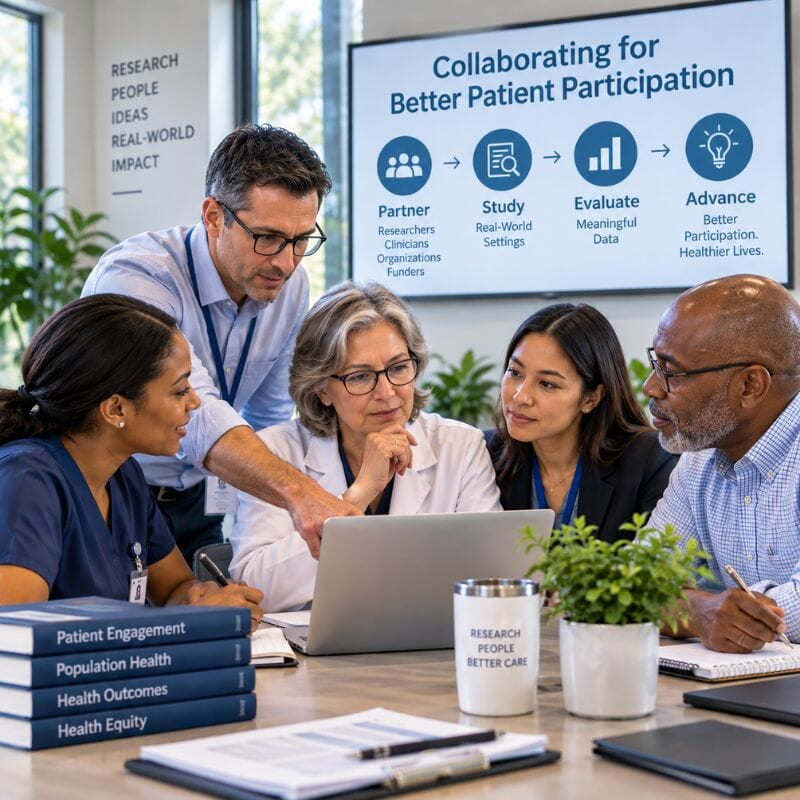
Healthcare researchers and clinicians collaborating on patient participation research, study design, and real-world healthcare outcomes.

Bring us your research question, your patient population, your clinical setting, or your funding interest. Together, we can build the evidence for patient participation.

Older adults and caregivers participating in healthcare through medical appointments, care discussions, and at-home health management.


​How We Study Patient Participation

Patient Better has already developed tools to measure participation behaviors, and readiness. Now we need research that puts those tools to work and validating them across populations and care settings, examining how participation relates to health behaviors and outcomes, and determining what changes when patients are better equipped to participate.


Help People Participate More Effectively in Their Care

Improving health requires more than access to healthcare. People also need the knowledge, skills, and practical ability to participate in the care they receive.

Prepare

Give people the organizational skillsto gather their health information, identify concerns, prepare questions, and establish priorities before a healthcare encounter.

Navigate

Give people the navigation skillsto understand where to go, what to do next, coordinate across professionals and services, and move through the healthcare system more effectively.


Communicate

Strengthen people's ability to exchange meaningful information with healthcare professionals, ask questions, understand instructions, and participate in decisions.

Improve Outcomes

Give people the opportunity to improve their health outcomesby strengthening their ability to participate, make informed decisions, and follow through with their care.

Welcoming Partnerships

We welcome partnerships with academic institutions, independent researchers, healthcare professionals, health systems, health plans, public health organizations, government agencies, foundations, and patient and caregiver communities interested in advancing the science of patient participation.

Patient participation presents an opportunity to study a part of healthcare that is routinely expected of patients but has not been fully defined, taught, or measured as its own area of health behavior.


The Patient Better Project welcomes academic institutions interested in helping build the evidence base surrounding patient participation. Research may examine how patient participation is defined and measured, how participation skills are learned, whether those skills change over time, how they appear across different populations and care settings, and how participation relates to communication, care navigation, patient experience, health behaviors, and other measurable outcomes.


Examples of organizations in this field: Academic medical centers; schools of medicine, nursing, public health, pharmacy, psychology, and allied health; university health services and health policy research centers; and institutions such as Johns Hopkins University, Harvard University, the University of Michigan, Duke University, and The University of Texas institutions. These are examples of the types of academic organizations that may conduct relevant work and do not imply an existing partnership or affiliation with The Patient Better Project.


Collaboration with The Patient Better Project through investigator-led studies, student and faculty research, measurement development and validation, pilot studies, implementation research, dissertations, publications, or multidisciplinary research involving fields such as health services research, public health, behavioral science, health literacy, nursing, medicine, psychology, and healthcare administration.


The Patient Better Project can contribute an established patient-participation framework, educational intervention, defined patient-side activities, measurement methodology under development, and opportunities for real-world study. Academic partners bring the independent scientific expertise necessary to test, challenge, validate, and refine that work.


Why participate? Because this is an opportunity not simply to study another patient education program, but to help determine how patient participation itself can be scientifically understood, measured, and investigated.


Health services researchers examine how healthcare is organized, delivered, accessed, experienced, and used. Patient participation belongs within that conversation because healthcare delivery does not end with the actions of the healthcare professional or organization. Patients also carry information between encounters, communicate changes, coordinate across providers, manage instructions, prepare for appointments, and follow through with care outside the clinical setting.


Examples of organizations in this field: Academic health services research centers, health-system research institutes, health policy research organizations, AcademyHealth, and the Agency for Healthcare Research and Quality (AHRQ).


The Patient Better Project welcomes health services researchers interested in examining this patient-side contribution to healthcare delivery. Research can explore where patient participation affects the movement of information and care across the healthcare system, how participation varies among populations and settings, what barriers make participation more difficult, and whether structured patient education can strengthen specific participation behaviors.


Potential areas of study include care coordination, continuity of care, healthcare navigation, communication, access, utilization, patient experience, transitions of care, treatment follow-through, administrative burden, and the relationship between patient participation and the processes healthcare organizations already measure.


Health services researchers may collaborate with The Patient Better Project through observational studies, pilot studies, implementation research, comparative studies, mixed-methods research, secondary data analysis, real-world evaluation, measurement development, and studies examining Patient Better as an educational intervention within healthcare delivery.


The Patient Better Project can contribute a defined patient-participation framework, structured educational intervention, observable patient-side activities, measurement methodology under development, and opportunities for real-world investigation. Health services researchers bring the methodological expertise needed to determine where patient participation fits within healthcare delivery and how it can be studied alongside existing measures of access, quality, experience, utilization, and care processes.


Why participate? Because health services research has extensively studied what healthcare systems and professionals do. Patient participation creates an opportunity to more deliberately investigate the work occurring on the other side of healthcare delivery: what patients must understand, organize, communicate, manage, and carry forward for care to continue from one encounter to the next.


Examples of professionals and organizations in this field: Physicians and physician investigators; nurses and nurse researchers; nurse practitioners and physician associates; pharmacists; physical and occupational therapists; behavioral health professionals; care managers; clinical research professionals; academic medical centers; teaching hospitals; practice-based research networks; clinical research institutes; and professional research communities such as the Association of Clinical Research Professionals (ACRP) and Society of Clinical Research Associates (SOCRA). These are examples of the types of professionals and organizations that may conduct relevant work and do not imply an existing partnership or affiliation with The Patient Better Project.


Healthcare professionals are positioned to observe patient participation where it actually occurs: during the everyday delivery of care. They see what happens when patients arrive prepared or unprepared, bring accurate or incomplete information, understand or misunderstand instructions, ask questions, organize their health information, and attempt to carry a care plan forward after leaving the clinical encounter.


The Patient Better Project welcomes physicians, nurses, advanced practice providers, pharmacists, therapists, psychologists, social workers, care managers, and other licensed healthcare professionals interested in helping investigate patient participation in real-world clinical environments. We also welcome clinical investigators interested in designing and conducting studies that examine patient participation as a measurable component of healthcare delivery.


Research opportunities may examine how patient-participation behaviors appear during clinical encounters, whether structured education changes those behaviors, how healthcare professionals recognize and respond to different levels of patient participation, and how participation relates to communication, understanding, preparedness, care coordination, treatment follow-through, patient experience, and other measurable care processes and outcomes.


Healthcare professionals and clinical investigators may participate through investigator-initiated studies, practice-based research, observational studies, intervention studies, pilot programs, feasibility studies, implementation research, measurement and instrument validation, patient recruitment, clinical-site participation, qualitative interviews, case studies, and multidisciplinary research collaborations.


The Patient Better Project can contribute a defined patient-participation framework, structured educational intervention, observable patient-side activities, measurement methodology under development, research questions, and opportunities for real-world investigation. Healthcare professionals and clinical investigators contribute clinical expertise, direct observation of patient behavior, access to appropriate research environments and populations, and the scientific and practical insight needed to determine whether measures of patient participation reflect what actually occurs in healthcare.


Why participate? Because healthcare professionals routinely depend on patients to provide information, understand decisions, manage instructions, communicate changes, and continue care between encounters. Clinical research provides an opportunity to move those expectations beyond assumption and examine them systematically: what patients are being asked to do, what they are actually able to do, what can be taught, what can be measured, and what difference those activities may make.


to provide real-world settings and patient populations for observational studies, pilots, and trials.

particularly for large-population studies involving utilization, quality measures, member experience, adherence, and outcomes.

to investigate participation at community and population levels.

because participation involves behavior, habits, communication, decision-making, self-management, and environmental factors.

especially important for validating the Healthcare Proficiency Challenge, readiness measures, scoring, reliability, construct validity, responsiveness, and population differences.

to compare and distinguish patient participation from existing constructs and measures.

to determine whether participation measures are associated with clinical outcomes, patient experience, quality, safety, and utilization.

potentially including HHS agencies such as NIH, AHRQ, and CMS, as well as the VA, depending on the research question, population, and funding mechanism.

because somebody ultimately has to finance investigator-initiated studies, validation studies, pilots, and larger-scale research.

to study patient participation where much of day-to-day health management occurs, including how individuals organize health information, follow care instructions, manage appointments and medications, navigate services, and maintain continuity between healthcare encounters.

Understanding Patient Participation

Patient participation is expected throughout healthcare, yet the activities patients perform to participate in their care have not been consistently defined or measured as a distinct area of study.


The Patient Better Project is working to change that. Our research examines what patients are expected to do before, during, and between healthcare encounters, how those activities can be identified and measured, and whether a person's ability to participate can be strengthened through education and support.


This research paper presents the foundation for that work. It defines patient participation, distinguishes it from related concepts such as health literacy, patient engagement, and patient activation, and outlines a framework for studying patient participation as a measurable component of healthcare.